Big Joe Williams Baby Please Don't Go Youtube
| "Baby, Delight Don't Get" | |
|---|---|
 | |
| Single by Joe Williams' Washboard Blues Singers | |
| B-side | "Wild Moo-cow Dejection" |
| Released | 1935 (1935) |
| Recorded | Chicago, Oct 31, 1935 |
| Genre | Blues |
| Length | 3:22 |
| Label | Bluebird |
| Songwriter(south) | Traditional (J. Williams credited on tape) |
| Producer(due south) | Lester Melrose |
"Infant, Please Don't Go" is a traditional blues song that was popularized by Delta dejection musician Big Joe Williams in 1935. Many cover versions followed, leading to its clarification every bit "one of the most played, arranged, and rearranged pieces in dejection history" by French music historian Gérard Herzhaft.[1]
Afterwards World War II, Chicago blues and rhythm and dejection artists adjusted the song to newer music styles. In 1952, a doo-wop version past the Orioles reached the top ten on the R&B chart. In 1953, Muddy Waters recorded the song equally an electric Chicago-ensemble blues piece, which influenced many subsequent renditions. By the early 1950s, the song became a blues standard.
In the 1960s, "Baby, Please Don't Go" became a popular rock vocal afterward the Northern Irish gaelic group Them recorded it in 1964. Jimmy Page, a studio guitarist at the time, participated in the recording session, perchance on rhythm guitar. Subsequently, Them'southward uptempo stone arrangement besides made it a rock standard. Ac/DC and Aerosmith are among the stone groups who have recorded the song. "Baby, Delight Don't Go" has been inducted into both the Blues and Rock and Roll Halls of Fame.
Background [edit]
"Infant, Please Don't Get" is likely an adaptation of "Long John", an old folk theme which dates dorsum to the fourth dimension of slavery in the U.s.a..[1] Dejection researcher Paul Garon notes that the tune is based on "Alabamy Bound", composed past Can Pan Alley writer Ray Henderson, with lyrics by Buddy DeSylva and Bud Dark-green in 1925.[ii] [a] The song, a vaudeville evidence melody, inspired several other songs between 1925 and 1935, such as "Elder Greene Blues", "Alabama Jump", and "Don't You Leave Me Hither".[2] [iii] These variants were recorded by Charlie Patton, Pb Belly, Monette Moore, Henry Thomas, and Tampa Red.[2]
Author Linda Dahl suggests a connection to a song with the same title by Mary Williams Johnson in the belatedly 1920s and early 1930s.[4] Withal, Johnson, who was married to jazz-influenced blues guitarist Lonnie Johnson, never recorded it and her song is non discussed as influencing after performers.[i] [3] [5] Blues researcher Jim O'Neal notes that Williams "sometimes said that the song was written past his wife, vocaliser Bessie Mae Smith (aka Blueish Belle and St. Louis Bessie)."[three]
Original vocal [edit]
Large Joe Williams used the imprisonment theme for his October 31, 1935, recording of "Babe, Please Don't Get". He recorded it during his first session for Lester Melrose and Bluebird Records in Chicago.[three] It is an ensemble slice with Williams on vocal and guitar accompanied by Dad Tracy on 1-string fiddle and Chasey "Kokomo" Collins on washboard, who are listed equally "Joe Williams' Washboard Dejection Singers" on the single.[3] Musical annotation for the song indicates a moderate-tempo fifteen-bar dejection in 4
iv or common fourth dimension in the key of B apartment.[6] [b] As with many Delta blues songs of the era, it remains on the tonic chord (I) throughout without the progression to the subdominant (IV) or dominant (V) chords.[vi] The lyrics express a prisoner's anxiety about his lover leaving before he returns home:[8]
Now baby please don't become, now baby please don't go
Infant delight don't go back to New Orleans, and get your cold ice cream
I believe there'due south a man washed gone, I believe there'southward a man done gone
I believe there's a man washed gone to the county subcontract, with a long chain on
The song became a hit and established Williams' recording career.[nine] On December 12, 1941, he recorded a second version titled "Delight Don't Go" in Chicago for Bluebird, with a more than modern arrangement and lyrics.[ten] Dejection historian Gerard Herzhaft calls it "the virtually exciting version",[1] which Williams recorded using his trademark 9-string guitar. Accompanying him are Sonny Male child Williamson I on harmonica and Alfred Elkins on imitation bass (mayhap a washtub bass).[11] Since both songs appeared before recording manufacture publications began tracking such releases, it is unknown which version was more than pop. In 1947, he recorded it for Columbia Records with Williamson and Ransom Knowling on bass and Estimate Riley on drums.[2] This version did not attain the Billboard Race Records chart,[12] but represents a move toward a more urban blues treatment of the song.
Later blues and R&B recordings [edit]
Big Joe Williams' various recordings inspired other blues musicians to tape their interpretations of the vocal[thirteen] and information technology became a blues standard.[i] Early on examples include Papa Charlie McCoy every bit "Tampa Child" (1936), Leonard "Baby Doo" Caston (1939), Lightnin' Hopkins (1947), John Lee Hooker (1949), and Large Bill Broonzy (1952).[xiv] By the early 1950s, the song was reworked in gimmicky musical styles, with an early rhythm and blues/jump blues version by Baton Wright (1951),[1] a harmonized doo-wop version by the Orioles (a number viii R&B hit in 1952),[c] and an Afro-Cuban-influenced rendition by Rose Mitchell (1954).[i] Mose Allison recorded the tune in his jazz-blues piano style for the album Transfiguration of Hiram Dark-brown (1960).[15]
In 1953, Muddy Waters recast the vocal equally a Chicago-blues ensemble piece with Fiddling Walter and Jimmy Rogers.[16] Chess Records originally issued the single with the title "Turn the Lamp Down Low", although the song is besides referred to as "Turn Your Lamp Downwards Low",[iii] "Plow Your Light Downward Low",[14] or "Infant Please Don't Go".[d] He regularly played the song, several performances were recorded. Live versions appear on Muddy Waters at Newport 1960 and on Alive at the Checkerboard Lounge, Chicago 1981 with members of the Rolling Stones.[17] AllMusic critic Bill Janovitz cites the influence of Waters' adaptation:
The almost likely link between the Williams recordings and all the stone covers that came in the 1960s and 1970s would be the Dingy Waters 1953 Chess side, which retains the same swinging phrasing as the Williams takes, merely the session musicians beef it upward with a steady driving rhythm department, electrified instruments and Little Walter Jacobs wailing on blues harp.[xviii]
Van Morrison and Them rendition [edit]
| "Baby, Please Don't Get" | ||||
|---|---|---|---|---|
 | ||||
| Unmarried past Them | ||||
| B-side | "Gloria" | |||
| Released |
| |||
| Recorded | October 1964 | |||
| Genre | Blues rock | |||
| Length | ii:40 | |||
| Label |
| |||
| Songwriter(due south) | Traditional (Williams credited) | |||
| Producer(s) | Bert Berns | |||
| Them singles chronology | ||||
| ||||
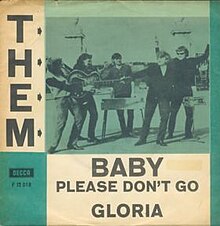
"Babe Delight Don't Go" was i of the earliest songs recorded past Them, fronted by a 19-year-old Van Morrison. Their rendition of the song was derived from a version recorded past John Lee Hooker in 1949 as "Don't Get Baby".[19] [e] Hooker's vocal later appeared on a 1959 album, Highway of Blues, which Van Morrison heard and felt was "something actually unique and different" with "more soul" than he had previously heard.[19]
Recording and limerick [edit]
Them recorded "Baby, Please Don't Go" for Decca Records in October 1964. Besides Morrison, there is conflicting data about who participated in the session. In improver to the group's original members (guitarist Baton Harrison, bassist Alan Henderson, drummer Ronnie Millings, and keyboard player Eric Wrixon), others have been suggested: Pat McAuley on keyboards, Bobby Graham on a 2nd pulsate kit, Jimmy Page on second guitar,[20] and Peter Bardens on keyboards.[21] As Page biographer George Case notes, "At that place is a dispute over whether it is Page'south piercing blues line that defines the vocal, if he only played a run Harrison had already devised, or if Page only backed up Harrison himself".[22] Morrison has acknowledged Folio's participation in the early sessions: "He played rhythm guitar on one thing and doubled a bass riff on the other"[23] and Morrison biographer Johnny Rogan notes that Page "doubled the distinctive riff already worked out by Billy Harrison".[23]
Janovitz identifies the riff every bit "the backbone of the arrangement" and describes Henderson's contribution as an "amphetamine-blitz, pulsing two-annotation bass line."[18] [f] Music critic Greil Marcus comments that during the song's quieter middle passage "the guitarist, session player Jimmy Page or not, seems to be feeling his way into another song, flipping one-half-riffs, loftier, random, distracted metal shavings".[24] [one thousand] Them'due south blues rock arrangement is "now regarded justly as definitive", co-ordinate to music writer Alan Clayson.[26]
Releases and charts [edit]
Decca released "Babe, Please Don't Get" as Them'southward second single on November half dozen, 1964.[20] With the B-side, "Gloria", it became their first hit, reaching number x on the U.k. Singles Chart in February 1965.[27] In the U.s., the single was released past Parrot Records.[28] On March xx, Billboard magazine showtime listed the vocal on its extended "Bubbling Under the Hot 100" chart,[29] where information technology eventually peaked at number 102 on April 24.[30] The single fared better on the West Coast, where both songs appeared on weekly Peak 40 playlists for Los Angeles radio station KRLA between March and June 1965, reaching number i for 3 weeks in April.[31] [32] [33] Cash Box described information technology equally "a funky, hard-driving pleader that the fellas stone out with telling effect".[34]
The song was not included on Them's original British or American albums (The Angry Young Them and Them Again), all the same, it has appeared on several compilation albums, such as The Story of Them Featuring Van Morrison and The Best of Van Morrison.[35] When information technology was reissued in 1991 as a unmarried in the UK, it reached number 65 in the chart.[27] Van Morrison also accompanied John Lee Hooker during a 1992 performance, where Hooker sings and plays "Baby, Delight Don't Go" on guitar while sitting on a dock, with harmonica backing past Morrison; information technology was released on the 2004 Come Run across Nearly Me Hooker DVD.[36]
Ac/DC version [edit]
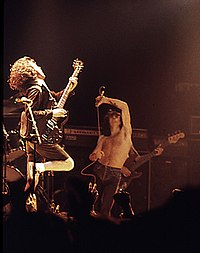
Angus Immature and Bon Scott at the Ulster Hall in August 1979
"Baby, Delight Don't Go" was a feature of Ac/DC'due south live shows since their beginning.[37] Although they have expressed their interest and inspiration in early blues songs,[38] music writer Mick Wall identifies Them'southward adaptation of the song every bit the likely source.[39] In Nov 1974, Angus Young, Malcolm Immature, and Bon Scott recorded it for their 1975 Australian debut album, High Voltage.[38] Tony Currenti is sometimes identified equally the drummer for the song, although he suggests that it had been already recorded by Peter Ballyhoo.[forty] Wall notes that producer George Young played bass for well-nigh of the album,[39] although Rob Bailey claims that many of the album's tracks were recorded with him.[41]
High Voltage and a single with "Babe, Please Don't Go" were released simultaneously in Australia in February 1975.[41] [h] AllMusic critic Eduardo Rivadavia called the song "positively explosive".[42] Albert Productions issued information technology as the single'due south B-side. Notwithstanding, the A-side "Honey Song (Oh Jene)" was largely ignored and "Babe, Please Don't Go" began receiving airplay.[39] The single entered the chart at the terminate of March 1975[43] and peaked at number 10 in April.[44] Also on March 23, 1975, one month after drummer Phil Rudd and bassist Mark Evans joined Air-conditioning/DC, the group performed the song for the first fourth dimension (this operation would also be repeated on April 6 and 27, which is why there is often conflicting dates for this performance) on the Australian music programme Countdown.[45] [46] For their appearance, "Angus wore his trade marking schoolboy compatible while Scott took the phase wearing a wig of blonde braids, a dress, make-up, and earrings", according to writer Heather Miller.[45] Joe Bonomo describes Scott every bit "a demented Pippi Longstocking", and Perkins notes his "tattoos and a disturbingly brusque skirt."[38] Evans describes the reaction:
As soon as his vocals are virtually to begin he comes out from behind the drums dressed as a schoolgirl. And information technology was like a bomb went off in the joint; it was pandemonium, everybody broke out in laughter. [Scott] had a wonderful sense of humor.[45]
Scott mugs for the camera and, during the guitar solo/vocal improvization section, he lights a cigarette as he duels with Angus with a green mallet.[46] Rudd laughs throughout the performance.[46] Although "Baby, Delight Don't Get" was a popular part of Ac/DC's performances (ofttimes every bit the closing number), the song was not released internationally until their 1984 compilation EP '74 Jailbreak.[38] The video from the Inaugural testify is included on 2005'due south Family Jewels DVD compilation.
Aerosmith version [edit]
Aerosmith recorded "Baby, Please Don't Go" for their blues cover album, Honkin' on Bobo, which was released on March 30, 2004.[47] The anthology was produced past Jack Douglas, who had worked on the grouping'due south earlier albums, and reflects a return to their hard rock roots.[47] Billboard magazine describes the song as "the kind of directly-alee, difficult-driving track that always typified the band'due south [1970s] records".[48] Edna Gundersen of United states Today chosen their version a "terrific revival."[49] It was the starting time single to be released from the album and reached number seven on the Mainstream Stone Tracks chart.[l] A music video, directed past Mark Haefeli, was produced to promote the unmarried.[51] Subsequently, the song has become a staple of the band's concert repertoire.[52] [53]
Recognition and legacy [edit]
"Baby, Please Don't Become" is recognized every bit a blues standard, including by French blues historian Gérard Herzhaft, who described it as "one of the almost played, arranged, and rearranged pieces in blues history".[1] The Stone and Roll Hall of Fame included Big Joe Williams' rendition in list of "500 Songs That Shaped Rock and Gyre".[54] In 1992, Williams' song was inducted into the Blues Foundation Hall of Fame in the "Classics of Blues Recordings" category.[3] Writing for the Foundation, Jim O'Neal noted that, in improver to various dejection recordings, "the song was revived in revved-up fashion by rock bands in the '60s such equally Them, the Amboy Dukes, and Ten Years After".[3]
In 1967, the Amboy Dukes recorded the vocal for their cocky-titled debut album. An album review mentions Them'southward version, but adds that the Amboy Dukes' "Ted Nugent and the boys totally twist information technology to their bespeak-of-view, even tossing a complete Jimi Hendrix [guitar line from "Third Stone from the Sunday"] nick into the mix."[55] Released as a single, it reached number 106 on Billboard 's extended "Bubbling Nether the Hot 100" chart.[56] In 1969, Ten Years After included some lyrics from "Baby, Please Don't Become" during their performance of "I'm Going Home" at the Woodstock festival in Bethel, New York.[57] Alvin Lee's ten-infinitesimal guitar workout was a highlight of the event'southward 1970 documentary film,[58] which "would cement their reputation for decades to come up".[59]
Notes [edit]
Footnotes
- ^ An before "I'k Alabama Jump", with its own recording history, was published by Robert Hoffman in 1909.
- ^ The sheet music includes a 1944 copyright engagement, indicating a later version of the song[7] (Williams' 1935 recording is in the primal of B).
- ^ Music historian Larry Birbaum suggested that the Orioles' 1951 version inspired James Dark-brown'south starting time hit "Please, Please, Please" (1956).[5]
- ^ Muddy Waters' original Chess single lists the songwriters every bit "Strutt, Alexander", although reissues credit "McKinley Morganfield" (his legal name). The song is registered as "Turn the Lamps [sic] Downwards Depression" with Joseph Lee Williams equally the songwriter. ISWC T-070.278.618-two.
- ^ John Lee Hooker was listed equally "Texas Slim" on the single "Don't Go Baby" (Rex 4334).
- ^ Janovitz claims that Henderson's bass line "was later lifted by Gilded Earring for 'Radar Honey'".[18]
- ^ Offset about 1:22 in Them'due south recording, bassy-sounding riffs appear.[25]
- ^ The Albert Productions Ac/DC single misidentified the songwriter as Large Bill Broonzy.[41]
Citations
- ^ a b c d east f yard h Herzhaft 1992, p. 437.
- ^ a b c d Garon 2004, p. 39.
- ^ a b c d e f grand h O'Neal, Jim (1992). "1992 Hall of Fame Inductees: "Baby Delight Don't Go" – Large Joe Williams (Bluebird 1935)". The Blues Foundation . Retrieved April 26, 2015.
- ^ Dahl 1984, p. 110.
- ^ a b Birnbaum 2012, p. 302.
- ^ a b Hal Leonard 1995, pp. 17–19.
- ^ Hal Leonard 1995, p. 17.
- ^ Gioia 2008, p. 130.
- ^ Herzhaft 1992, p. 381.
- ^ Demetre 1994, p. 23.
- ^ Demetre 1994, p. 29.
- ^ Whitburn 1988, pp. 444–445.
- ^ Escott 2002, p. 54.
- ^ a b Garon 2004, p. forty.
- ^ Greenwald, Matthew. "Mose Allison: Baby Delight Don't Become, Equanimous past Big Joe Williams". AllMusic . Retrieved September 28, 2019.
- ^ Palmer 1989, p. 28.
- ^ Gordon 2002, p. 266.
- ^ a b c Janovitz, Bill. "Large Joe Williams: 'Babe Please Don't Get' – Review". AllMusic . Retrieved July 2, 2018.
- ^ a b Murray 2002, pp. 212, 302.
- ^ a b Thompson 2008, p. 303.
- ^ Potent 2002, eBook.
- ^ Case 2007, p. 35.
- ^ a b Rogan 2006, pp. 101, 111.
- ^ Marcus 2010, eBook.
- ^ Them (1964). Baby, Delight Don't Go (Song recording). London: Decca Records. Effect occurs at 1:22. F.12018.
- ^ Clayson 2006, p. 61.
- ^ a b "Them – Singles". Official Charts . Retrieved April 26, 2015.
- ^ Billboard 1965a, p. 39.
- ^ Billboard 1965b, p. 24.
- ^ Billboard 1965c, p. 26.
- ^ Vanquish 1965a, p. four.
- ^ Beat out 1965b, p. iv.
- ^ Shell 1965c, p. 3.
- ^ CashBox 1965, p. 18.
- ^ "Them: 'Babe Please Don't Go' – Appears On". AllMusic . Retrieved September 28, 2019.
- ^ Viglione, Joe. "John Lee Hooker: Come and See Near Me – Review". AllMusic . Retrieved September 28, 2019.
- ^ Walker 2011, p. 135.
- ^ a b c d Perkins 2011, eBook.
- ^ a b c Wall 2013, eBook.
- ^ Fink 2014, p. 83.
- ^ a b c Walker 2011, p. 139.
- ^ Rivadavia, Eduardo. "AC/DC: Loftier Voltage (Commonwealth of australia) – Review". AllMusic . Retrieved Apr 26, 2015.
- ^ Walker 2011, p. 145.
- ^ Walker 2011, p. 148.
- ^ a b c Miller 2009, eBook.
- ^ a b c Bonomo 2010, eBook.
- ^ a b Erlewine, Stephen Thomas. "Aerosmith: Honkin' on Bobo – Review". AllMusic . Retrieved April 26, 2015.
- ^ Billboard 2004, pp. thirteen, 15.
- ^ Gundersen, Edna (March 29, 2004). "Clapton, Aerosmith fiddle in the blues". USA Today. Gannett Company. Retrieved July 1, 2015.
- ^ "Aerosmith: Chart History – Mainstream Rock Songs". Billboard.com . Retrieved September 28, 2019.
- ^ "Aerosmith: 'Infant Please Don't Become' Video Posted Online". Blabbermouth.net. May 20, 2004. Retrieved July 1, 2015.
- ^ Hauk, Hunter (August vi, 2010). "Concert review: Aerosmith at Superpages.com Center". The Dallas Morning News. A.H. Belo. Retrieved July 1, 2015.
- ^ Stingley, Mick (October fourteen, 2010). "Aerosmith/The J. Geils Ring – Concert Review". The Hollywood Reporter. Prometheus Global Media. Retrieved July one, 2015.
- ^ "500 Songs that Shaped Stone and Roll". Stone and Roll Hall of Fame. 1995. Archived from the original on April 22, 2007. Retrieved April 26, 2015.
- ^ Viglione, Joe. "The Amboy Dukes – Review". AllMusic . Retrieved January 30, 2022.
- ^ Whitburn 2008, p. 17.
- ^ Moore 2004, p. 81.
- ^ Jurek, Thom. "Woodstock – Review". AllMusic . Retrieved January 30, 2022.
- ^ Deming, Mark. "10 Years After – Biography". AllMusic . Retrieved January 30, 2022.
References
- "KRLA Tunedex". KRLA Vanquish. Apr fourteen, 1965.
- "KRLA Tunedex". KRLA Beat. April 21, 1965.
- "KRLA Tunedex". KRLA Beat. April 28, 1965.
- "Single Reviews – Chart Specials". Billboard. Vol. 77, no. 5. Jan thirty, 1965a. ISSN 0006-2510.
- "Bubbling Under the Hot 100". Billboard. Vol. 77, no. 12. March 20, 1965b. ISSN 0006-2510.
- "Bubbling Under the Hot 100". Billboard. Vol. 77, no. 17. April 24, 1965c. ISSN 0006-2510.
- "'Honk' if You Love Old Aerosmith". Billboard. Vol. 116, no. fourteen. April 3, 2004. ISSN 0006-2510.
- "CashBox Record Reviews" (PDF). Cash Box. Jan 30, 1965. Retrieved January 12, 2022.
- Birnbaum, Larry (2012). Before Elvis: The Prehistory of Rock 'north' Gyre. Lanham, Maryland: Scarecrow Press. ISBN978-0-8108-8629-2.
- Bonomo, Joe (2010). AC/DC's Highway To Hell. The states: Bloomsbury Publishing. ISBN978-1441141583.
- Case, George (2007). Jimmy Page: Magus, Musician, Man – An Unauthorized Biography. Hal Leonard. ISBN978-1-4234-0407-1.
- Clayson, Alan (2006). Led Zeppelin: The Origin of the Species. Chrome Dreams. ISBN1-84240-345-1.
- Dahl, Linda (1984). Stormy Weather. Proscenium.
- Demetre, Jacques (1994). The Prewar Dejection Story 1926–1943 (CD compilation booklet). Various artists. All-time of Blues. OCLC 874878605. Best of Blues 20.
- Escott, Colin (2002). B.B. King: The Vintage Years (Box set booklet). B.B. King. Great britain: Ace Records. OCLC 52004950. Ace ABOXCD 8.
- Fink, Jesse (2014). The Youngs: The Brothers Who Built Air-conditioning/DC. New York Metropolis: St. Martin's Press. ISBN978-1466865204.
- Garon, Paul (2004). "Infant Please Don't Go/Don't You Leave Me Here". In Komara, Edward (ed.). Encyclopedia of the Blues. New York City: Routledge. ISBN978-1135958329.
- Gioia, Ted (2008). Delta Blues (Norton Paperback 2009 ed.). New York Urban center: W. W. Norton. ISBN978-0-393-33750-1.
- Gordon, Robert (2002). Can't Be Satisfied: The Life and Times of Muddied Waters. Boston, Massachusetts: Niggling, Brown. ISBN0-316-32849-nine.
- Hal Leonard (1995). "Baby Please Don't Go". The Blues. Milwaukee, Wisconsin: Hal Leonard. ISBN0-79355-259-one.
- Herzhaft, Gerard (1992). "Infant, Please Don't Go". Encyclopedia of the Blues. Fayetteville, Arkansas: Academy of Arkansas Press. ISBN1-55728-252-eight.
- Marcus, Greil (2010). When That Crude God Goes Riding: Listening to Van Morrison. PublicAffairs. ISBN978-1-58648-821-5.
- Miller, Heather (2009). AC/DC: Hard Rock Band. Enslow. ISBN978-0766030312.
- Moore, Allan F. (2004). "The Contradictory Aesthetics of Woodstock". In Bennett, Andy (ed.). Remembering Woodstock. New York City: Routledge. ISBN978-0-7546-0714-iv.
- Murray, Charles Shaar (2002). Boogie Human being: The Adventures of John Lee Hooker in the American Twentieth Century. Macmillan. ISBN978-0-312-27006-three.
- Palmer, Robert (1989). Dirty Waters: Chess Box (Box set booklet). Muddied Waters. Universal City, California: Chess Records/MCA Records. OCLC 154264537. CHD3-80002.
- Perkins, Jeff (2011). AC/DC – Uncensored on the Tape. Coda Books. ISBN978-1908538543.
- Rogan, Johnny (2006). Van Morrison: No Surrender. Random Firm. ISBN978-0-09-943183-ane.
- Potent, Martin C. (2002). The Not bad Rock Discography. Canongate. ISBN978-one-84195-312-0.
- Thompson, Gordon (2008). Please Please Me: Sixties British Pop, Inside Out. Oxford University Press. ISBN978-0-nineteen-533318-3.
- Walker, Clinton (2011). Highway to Hell: The Life and Death of Air-conditioning/DC Legend Bon Scott. Verse Chorus Press. ISBN978-1891241864.
- Wall, Mick (2013). Air-conditioning/DC: Hell Ain't a Bad Place to Be. Macmillan. ISBN978-1250038753.
- Whitburn, Joel (1988). Top R&B Singles 1942–1988. Menomonee Falls, Wisconsin: Record Enquiry. ISBN0-89820-068-7.
- Whitburn, Joel (2008). Joel Whitburn Presents: Across the Charts – The 1960s. Menomonee Falls, Wisconsin: Tape Research. ISBN978-0898201758.
Source: https://en.wikipedia.org/wiki/Baby,_Please_Don%27t_Go
0 Response to "Big Joe Williams Baby Please Don't Go Youtube"
Post a Comment